
Table of Contents
- Why Water Runs Off Slopes (and What It Costs Your Garden)
- Step 1: Assess Your Slope, Soil, and Runoff Before You Build Anything
- Step 2: Slow the Water With Swales, Berms, and Trench Drains
- How to Prevent Soil Erosion on a Slope With Mulch, Gravel, and Stone
- Plants for Erosion Control on Slopes: What Actually Holds Soil
- Terracing a Garden Slope: Steps, Spacing, and Materials
- How to Water Plants on a Slope Without Losing Water to Runoff
- Maintenance, Inspection, and Fixing Drainage That Fails
- Frequently Asked Questions
Last Updated: October 21, 2026
Why Water Runs Off Slopes (and What It Costs Your Garden)
Water runoff on slopes is rain or irrigation water that fails to soak in and flows downhill. This guide from Garden Water Ring explains how to stop water runoff on slopes with simple, tool-free methods any home gardener can build.
The cost shows up fast. Erosion strips the nutrient-rich top layer, so vegetable plants sit in poorer ground.
Slope steepness decides how much you fight. A gentle grade loses a little soil; a steep slope sheds almost everything. Soil type matters too.
The good news: most home gardens don't need heavy equipment, just the right sequence. Slow the water first, spread it out, then anchor the soil with plants and ground cover.
Step 1: Assess Your Slope, Soil, and Runoff Before You Build Anything
Most runoff fixes fail because the gardener built before diagnosing. Before you dig a swale or set a single stone, spend an afternoon reading your site to decide which intervention fits, and where the water is allowed to go.
Read the slope, not just the puddle
Watch where water actually travels during a storm. Walk the yard in the first ten minutes of a downpour and note the channels surface water takes, those paths tell you more than any indoor plan.
Then put a number on the grade. You do not need surveying gear. Drive two stakes about 10 feet apart straight up the slope, tie a string between them at the same height on each stake, and measure how far the downhill string sits above the ground.
Test how fast your soil takes water
Dig a hole about 6 inches deep and wide, fill it with water, and let it drain. Refill it and time the second fill.
Soil texture drives this. A simple ribbon test helps: squeeze a moist ball of soil between your thumb and forefinger. A long ribbon that holds together signals high clay; a crumbly ball that won't ribbon signals sand or loam.
Estimate how much water you are actually handling
Runoff volume scales with the area draining into your slope, not just the slope itself. A useful rule of thumb: a 1-inch rain on a 10-by-10-foot area delivers roughly 60 gallons. If your uphill watershed is 20 by 20 feet, plan for roughly 240 gallons in a 1-inch storm, far more than one shallow swale can hold. That number tells you whether you need one swale or a chain of them.
Decide where the water is allowed to go
Diverted water has to land somewhere, and moving a problem downhill is not a fix. Before you build, identify a safe discharge point:
- A level, vegetated area where water can spread and soak in
- A rain garden sized to hold the volume from your estimate above
- A splash block or gravel apron that carries flow away from the foundation
Never dump concentrated flow onto a neighbor's property, a steep drop, or a paved surface that feeds a storm sewer. In many communities, local drainage rules govern how water leaves your lot, so check with your city or county before redirecting a large volume.
Write down your site assessment
Capture four things before you build:
- Where water enters the yard
- Where it exits or pools
- Which beds lose soil every year
- Your safe discharge point
That list points straight to the right solution and keeps you from building a swale that simply relocates the erosion.
Step 2: Slow the Water With Swales, Berms, and Trench Drains
The core principle of drainage on a slope is simple: slow the water before it gains speed. Fast water cuts channels; slow water soaks in.
A swale is a shallow, vegetated depression that runs across the slope, not down it, catching surface water and holding it long enough to infiltrate.
For heavier runoff, a trench drain or channel drain moves water to a safe spot.
Here's how the main options compare:
| Method | Best For | Effort | Maintenance |
|---|---|---|---|
| Swale and berm | Mild to moderate slopes | Low | Rake yearly |
| Trench drain | High runoff volume | Medium | Clear debris |
| Rock channel | Steep, fast flow | Medium | Re-stack stones |
| Terrace | Very steep garden beds | High | Check walls |
How to Prevent Soil Erosion on a Slope With Mulch, Gravel, and Stone
The fastest way to prevent soil erosion on a slope is to cover bare ground.
Spread a thick layer of mulch over exposed beds.
Rocks and boulders do more than look good. Placed across a slope, they act as small dams that slow water and spread it sideways.
Aim for full coverage. Any bare patch becomes the starting point for a washout.
Plants for Erosion Control on Slopes: What Actually Holds Soil
Deep-rooted plants are the long-term fix for a hillside. Their roots bind soil particles together and hold the slope long after mulch breaks down.
Choose plants for erosion control on slopes that match your light and moisture. Good choices include:
- Ornamental grasses with fibrous roots
- Low ground cover that spreads into a dense mat
- Native perennials suited to your region
- Shrubs with strong root systems on the steepest sections
Set plants close together so their roots overlap. A solid cover of ground cover beats scattered specimens every time.
The EPA guidance on managing runoff at home notes that vegetated cover reduces both erosion and the volume of stormwater leaving a site.
Terracing a Garden Slope: Steps, Spacing, and Materials
Terracing a garden slope turns one steep face into a series of level beds.
Build terraces from the bottom up. Set the first retaining wall at the base of the slope, then work upward.
Keep each terrace wide enough to garden. A narrow step is hard to plant and easy to erode.
A few rules that save rework:
- Never build a wall taller than you can safely stack by hand
- Leave weep holes so water drains through the wall
- Direct terrace runoff to a level spot, not down the face
For very steep ground, terraces are the most reliable option, and the most work.
How to Water Plants on a Slope Without Losing Water to Runoff
Watering a slope is where most gardeners lose the battle. Water applied too fast runs off before roots can drink. The fix is to deliver water slowly, close to the plant, and in amounts the soil can absorb before gravity pulls it away.
Why surface watering fails on a grade
On flat ground, water has time to spread and infiltrate. On a slope, gravity gives it a head start. A hose aimed at a plant's base sends most of its volume downhill within seconds, and what does soak in concentrates at the downhill edge of the root zone. Uphill roots stay dry while the downhill side stays wet, an uneven pattern that shows up as stunted, wilty plants even after a long watering session.
Deliver water to the root zone, not the surface
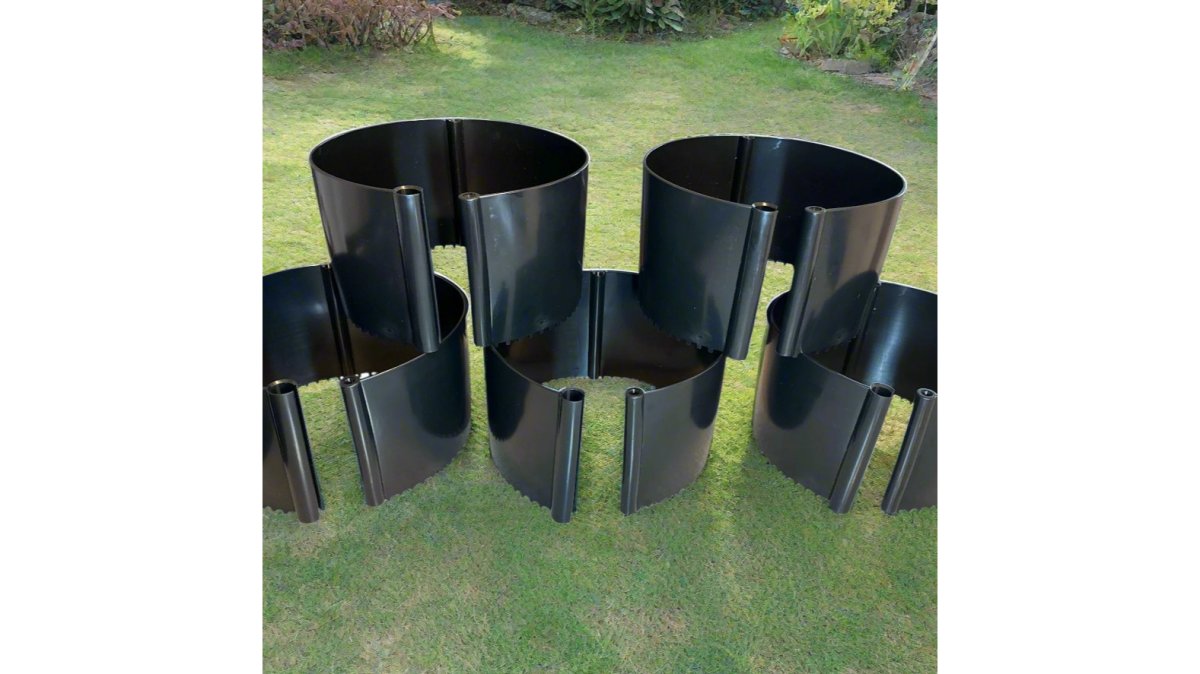
A root-zone watering ring solves the delivery problem. Garden Water Ring is a patented, reusable, USA-made one-piece ring that opens and closes with a sliding male/female locking system.
Open the ring, set it around the plant, and press the teeth into the soil. Fill the ring, and water seeps down to the root zone instead of racing downhill.
Time your watering to the soil, not the clock
On a slope, when you water matters as much as how. Water in the early morning so plants can drink before the day heats up and evaporation takes the rest. Water in cycles rather than one long soak: fill the ring, let it seep, then fill again. Two smaller applications absorb better than one large one that overwhelms the soil's intake rate.
Combine the ring with slope controls
For the steepest beds, pair the ring with a swale above the planting area. Slow the water uphill, then water precisely at the plant. Mulch around the ring to hold surface moisture and keep soil from splashing. The swale handles storm flow; the ring handles routine watering.
Troubleshoot common slope-watering problems
- Water pooling on one side of the ring: the bed is not level. Nudge soil under the low side or set the ring slightly deeper on the downhill edge.
- Ring tipping on a grade: press the holding spikes firmly into the soil and seat the teeth fully so the ring sits stable.
- Runoff escaping the ring on a steep bed: reduce the fill amount and add a second, smaller application after the first soaks in.
- Dry soil just outside the ring: that is expected, the ring targets the root zone, and surrounding plants get their own rings or their own watering.
For a closer look at how the ring installs and fits a hillside vegetable bed, see the Garden Water Ring product page | gardenwaterring.com.
Maintenance, Inspection, and Fixing Drainage That Fails
Drainage systems fail quietly, so check them on a schedule. Walk the slope after every major storm and look for new channels, pooled water, or exposed roots.
Common failures and their fixes:
- Clogged trench: clear leaves and silt before the rainy season
- Swale overflowing: deepen it or add a second swale uphill
- Undercut wall: backfill with gravel and add weep holes
- Bare patches: re-mulch immediately before the next downpour
Inspect retaining walls each spring for leaning or bulging. Small fixes early cost far less than a collapsed terrace later.
Frequently Asked Questions
How do you stop water runoff on a garden slope?
Start by finding where the water enters and exits your slope, then slow it down before it picks up speed. Shallow swales, mulch, gravel trenches, and terraced beds all interrupt the flow. For individual plants, a root-zone watering ring set about 2 inches into the soil holds water in place so it soaks in instead of sheeting downhill. Combine several methods rather than relying on one, since runoff on slopes is usually a volume problem, not a single-point problem.
Which plants help hold soil on a slope?
Look for deep-rooted perennials and ground covers that knit soil together. Native grasses, creeping juniper, sedum, and clumping ornamental grasses work well, and vegetables like squash and cucumbers can help once established. University extension programs recommend matching plants to your light and moisture conditions rather than picking one universal species. Plant in staggered rows across the slope, not straight up and down, so roots form barriers to water flow.
Does mulch help reduce runoff on a slope?
Yes, but the type matters. Coarse bark mulch and straw interlock and slow surface water, while fine mulch washes away in heavy rain. Apply 2 to 3 inches deep and keep it pulled back from plant stems. On steeper grades, pair mulch with a physical barrier like a trench or stone border, because mulch alone will not hold during a downpour. Replenish it each season as it breaks down.
How should you water vegetables growing on a slope?
Water slowly and close to the root zone instead of spraying the whole bed. A Garden Water Ring holds up to 2 gallons right around the plant, which gives water time to soak in rather than run downhill. Water in the morning, refill once the ring drains, and check by digging a small hole to see how far moisture reached. On mild slopes the ring stays put through its two 11-inch holding spikes.
Stopping runoff on a slope comes down to slowing water and getting it to the roots, not the storm drain. Garden Water Ring helps with that second part: a reusable, one-piece, USA-made ring that holds up to 2 gallons, installs in minutes without tools, and works on mild slopes. Orders ship directly from the manufacturer, and every purchase is backed by a 30-day money-back guarantee. Visit Garden Water Ring to shop the ring and give your sloped beds a smarter watering solution.

Leave a comment
This site is protected by hCaptcha and the hCaptcha Privacy Policy and Terms of Service apply.